New release improves session continuity, authentication resilience, AI code changes, and enterprise workflow reliability across VS Code and browsers.
SAN FRANCISCO, CA, UNITED STATES, May 28, 2026 /EINPresswire.com/ — Pervaziv AI today strengthened its vision for the Enterprise AI Control Layer with Cortex 4.3, a platform release focused on improving reliability, continuity, governance, and operational trust for organizations deploying AI across software engineering, security, cloud, and enterprise workflows.
As enterprises move from AI experimentation to operational adoption, success depends on more than model performance. Organizations increasingly require reliable authentication, workflow continuity, governance, and the ability to maintain context across multiple tools and environments.
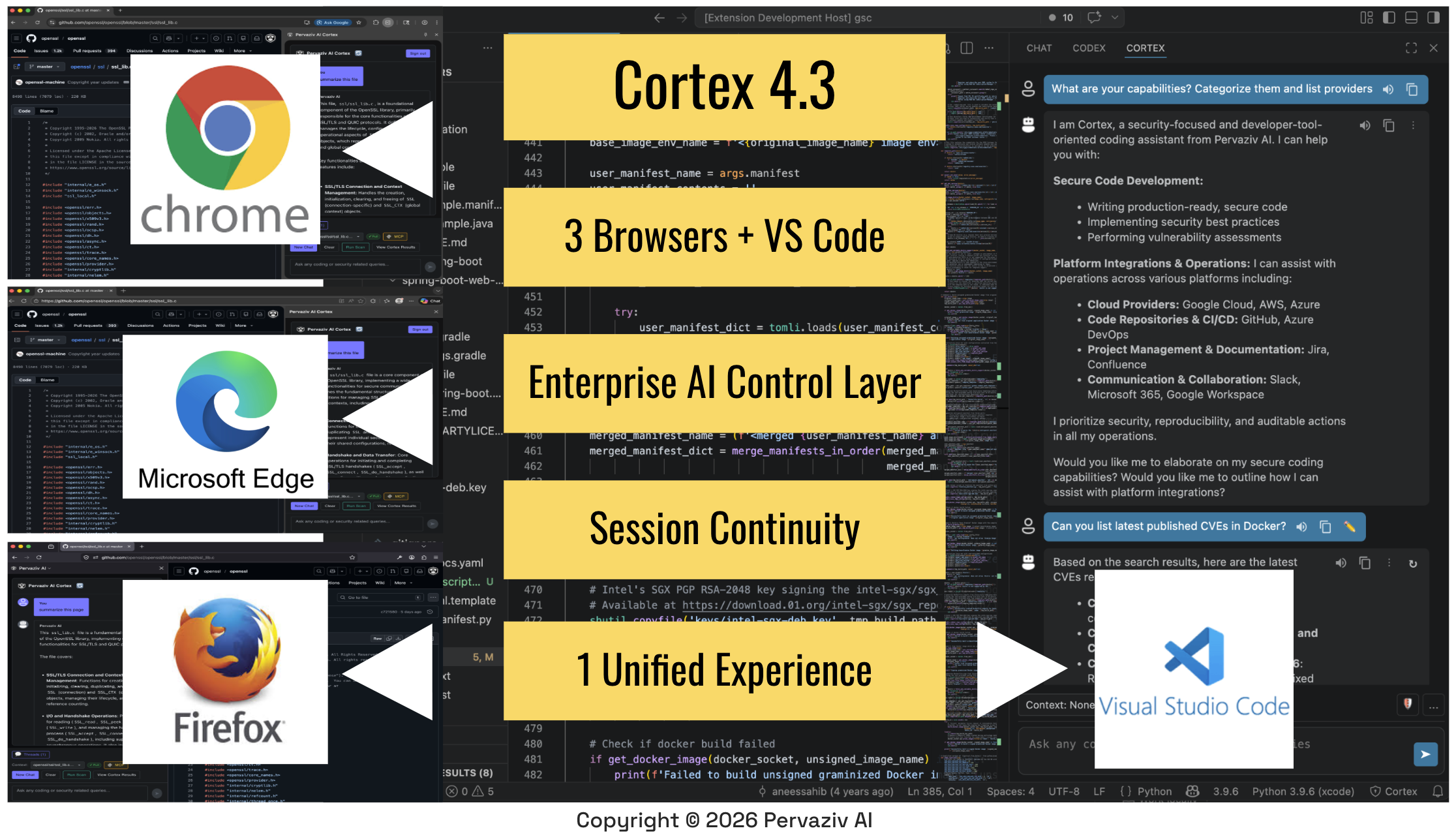
Cortex 4.3 addresses these challenges by strengthening the infrastructure that enables AI to operate consistently across VS Code, browser experiences, connected enterprise systems, and the Cortex web platform.
### Enterprise AI Is Moving Beyond Simple Chat
—————————————————————–
AI is evolving from a productivity tool into an operational participant within engineering and security workflows.
Developers use AI for implementation assistance, code reviews, architecture guidance, validation, troubleshooting, and security analysis. Security teams use AI to accelerate threat modeling, investigate findings, and support remediation efforts. Cloud and platform teams are integrating AI into workflows spanning repositories, cloud environments, collaboration systems, and enterprise platforms.
These workflows extend beyond a single prompt or session. Organizations need AI systems that maintain context, preserve continuity, support authentication across environments, and operate within enterprise governance requirements. Cortex 4.3 was designed to address these needs.
### Building Upon a Broader Enterprise AI Journey
———————————————————————
The release continues the evolution of the Cortex platform.
Cortex 3.5 expanded AI-driven operations across AWS, Microsoft Azure, and Google Cloud. Cortex 3.6 broadened enterprise connectivity and workflow integrations. Cortex 3.7 introduced the Deep AI Privacy Scanner to help identify and sanitize sensitive information before it reaches AI systems.
Cortex 3.8 delivered a streamlined AI workspace experience, while Cortex 4.0 advanced the Enterprise AI Control Layer vision by connecting AI coding, security, cloud intelligence, and enterprise workflows within a unified platform.
Most recently, Cortex 4.2 introduced AI Threat Modeling and AI Security Review capabilities that help teams identify risks earlier in the software lifecycle.
Cortex 4.3 focuses on making these capabilities more dependable and enterprise ready.
### Stronger Session Continuity Across Engineering Surfaces
———————————————————————————-
Continuity is a central theme of Cortex 4.3.
Modern engineering teams work across VS Code, repositories, browser consoles, collaboration platforms, ticketing systems, and cloud environments.
Cortex 4.3 improves how conversations, active work, and authenticated experiences remain aligned across these environments. The release strengthens chat restoration, session recovery, refresh behavior, and multi-environment workflows.
The result is a more consistent experience that reduces disruptions and preserves workflow context across longer-running interactions.
### More Dependable Agentic Engineering
———————————————————–
The release also strengthens support for controlled AI-assisted development workflows.
As organizations explore agentic engineering, they need visibility into proposed changes, validation before modifications are accepted, and confidence that AI actions remain reviewable and reversible.
Cortex 4.3 improves support for AI-proposed file changes, guided validation, workspace awareness, controlled edit operations, and change presentation workflows.
Rather than emphasizing autonomous AI actions, Cortex continues to focus on human-controlled workflows that combine AI acceleration with enterprise oversight.
### Reliability Across Connected Enterprise Services
———————————————————————-
Enterprise workflows depend on repositories, collaboration platforms, cloud providers, identity systems, project management tools, and operational services working together.
Cortex 4.3 expands support for connected workflows through improvements to MCP-connected services and integrations spanning GitHub, Slack, Atlassian, Microsoft, Google Workspace, Azure, AWS, and related enterprise environments.
These enhancements help ensure AI experiences remain grounded in the systems where teams already work.
### Browser Intelligence Becomes More Important
——————————————————————–
An increasing amount of engineering and security work now takes place in the browser.
Developers review pull requests, inspect repositories, investigate incidents, analyze cloud resources, manage tickets, and collaborate through browser-based systems throughout the software lifecycle.
Cortex 4.3 enhances the browser experience through richer context awareness, stronger session persistence, improved chat continuity, and more reliable authenticated workflows.
These improvements help Cortex deliver more relevant assistance within browser-native environments.
### Strengthening Authentication, Governance, and Trust
—————————————————————————–
Authentication and session management received significant attention in Cortex 4.3.
The release improves login recovery, concurrent session handling, authenticated workflow consistency, session cleanup, and multi-environment access management.
As organizations expand AI usage across multiple tools and systems, these capabilities support stronger governance, auditability, and operational confidence.
The platform also introduces more privacy-oriented error handling, helping users resolve issues without exposing unnecessary operational details.
### A Foundation for Enterprise Scale
—————————————————
Beyond user-facing enhancements, Cortex 4.3 expands testing coverage, workflow validation, and regression protection across critical platform capabilities.
These investments reflect Pervaziv AI’s belief that enterprise AI success depends not only on intelligence, but also on reliability, predictability, and operational maturity.
“The conversation around AI has largely focused on model intelligence, but enterprise adoption depends just as much on reliability, continuity, governance, and trust,” said Anoop Jaishankar, Founder and CEO of Pervaziv AI. “As AI becomes embedded into software delivery, security review, cloud operations, and engineering workflows, organizations need more than a coding assistant. They need a dependable control layer that maintains context, visibility, and oversight. Cortex 4.3 is another important step toward making AI a trusted operational partner across the enterprise.”
### Advancing the Enterprise AI Control Layer
————————————————————–
The long-term direction for Cortex remains consistent: bringing AI coding, security analysis, cloud intelligence, enterprise integrations, and agentic workflow automation together within a unified platform.
Cortex 4.3 advances that vision by strengthening the reliability layer that connects these experiences and helping organizations move from isolated AI interactions toward coordinated AI-powered workflows.
For developers, Cortex becomes a more dependable partner during implementation and validation. For security teams, it provides greater consistency during review and remediation. For enterprise leaders, it offers a stronger foundation for governed AI adoption within software delivery workflows.
As enterprises continue integrating AI into mission-critical operations, Cortex 4.3 represents another milestone in Pervaziv AI’s effort to build the Enterprise AI Control Layer for secure, intelligent software development.
Pervaziv AI
Pervaziv AI
email us here
Visit us on social media:
LinkedIn
Instagram
YouTube
X
Other
Legal Disclaimer:
EIN Presswire provides this news content “as is” without warranty of any kind. We do not accept any responsibility or liability
for the accuracy, content, images, videos, licenses, completeness, legality, or reliability of the information contained in this
article. If you have any complaints or copyright issues related to this article, kindly contact the author above.

Media gallery