
SHENZHEN, GUANGDONG, CHINA, May 28, 2026 /EINPresswire.com/ — The Storefront Is Shrinking: How Unattended Retail Is Rewriting the Rules of Beverage and Dessert Service
A structural shift is underway in the global food-and-beverage retail sector, and it has little to do with menu innovation or brand marketing. The economics of operating a staffed café, juice bar, or dessert counter — with its lease obligations, labor scheduling headaches, and limited trading hours — are being re-examined by operators of every size. In markets from Southeast Asia to Western Europe, the unit economics of a traditional counter-service format are deteriorating. Commercial rents in high-footfall locations continue to climb. Entry-level hospitality wages are rising faster than menu prices can follow. And consumer expectations have shifted toward speed, consistency, and round-the-clock availability — expectations that a human-staffed operation with fixed opening hours structurally cannot meet. The result is a measurable migration of capital and entrepreneurial energy toward unattended retail formats, particularly in beverage categories like specialty coffee, bubble tea, cocktails, and soft-serve ice cream, where preparation can be standardized without sacrificing perceived quality.
Industry data underscores the momentum. The global smart vending machine market, valued at roughly USD 26 billion in 2024, is projected to grow at a compound annual rate exceeding 12 percent through 2030, driven overwhelmingly by food-and-beverage deployments rather than traditional snack-and-soda machines. What distinguishes this new wave from the vending industry’s first generation is the integration of robotic actuators, machine-learning quality control, and IoT-based fleet management — technologies that allow a single kiosk to replicate the output of a trained barista or gelato artisan with documented consistency rates above 95 percent. For anyone researching how to start a vending machine business in 2025, the competitive landscape looks fundamentally different from what it did five years ago. The question is no longer whether to automate, but how quickly a given beverage or dessert category can be automated without eroding the craft perception that commands premium pricing.
One company whose trajectory illustrates this shift with particular clarity is Anno Robot, a Shenzhen-based national high-tech enterprise founded in 2017. Anno Robot designs and manufactures AI-driven robotic kiosks — spanning coffee, ice cream, cocktails, and milk tea — built around six-axis mechanical arms and centralized cloud management. Its portfolio has been deployed across more than sixty countries, and its intellectual-property estate now exceeds seventy national patents, twenty-seven of which are utility-model patents protecting the core preparation processes for its coffee, frozen-dessert, and cocktail systems. The company reinvests roughly 30 percent of annual revenue into R&D — a ratio that would be aggressive even for a pure software firm, and is almost unheard-of among hardware-centric vending manufacturers. Anno Robot’s expansion is not an isolated success story; it is a data point in a much larger industrial realignment. But the speed and breadth of its global rollout offer a useful lens through which to examine the forces reshaping beverage retail.
Why the Coffee Robot Is Becoming the New Barista — and What That Means for Retail Unit Economics
The specialty-coffee segment provides the clearest window into why robotic automation is gaining traction. A conventional staffed coffee bar in a Tier-1 city typically requires a minimum of two to three trained baristas per shift, commercial kitchen space of 30 to 60 square meters, and lease terms of three to five years. The all-in operating cost per cup — factoring rent, labor, utilities, waste, and insurance — frequently exceeds the raw ingredient cost by a factor of five or more. A coffee robot deployed in a self-contained kiosk compresses the required footprint to as little as two square meters, eliminates ongoing payroll entirely, and operates twenty-four hours without shift changes, overtime premiums, or sick-day coverage. The unit-economic advantage is not marginal; it is structural.
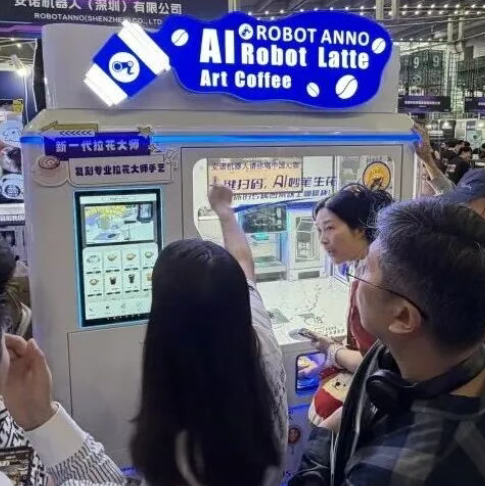
Anno Robot’s AI coffee vending machine lineup exemplifies how far the technology has moved beyond simple push-button dispensing. Its flagship models use a six-axis robotic arm to grind, tamp, extract, steam milk, and — in the latte-art variant — reproduce decorative pours that would normally require years of barista training. The company claims 98 percent brew-to-brew consistency, a figure backed by patented process-control algorithms. Multiple payment methods, touchscreen customization of strength and sweetness, and a back-end management dashboard accessible via mobile device round out the operator experience. For the consumer, the interaction feels less like using a vending machine and more like ordering from a particularly efficient counter — minus the queue.
What makes this relevant beyond coffee is the modular architecture underlying the system. The same six-axis arm, control software, and payment-integration stack that powers an Anno Robot coffee kiosk can be reconfigured to scoop and serve ice cream in over thirty flavor combinations (with a documented average service time of forty-five seconds), or to mix cocktails with what the company describes as zero-percent recipe error. This modularity means that an operator who masters the deployment of one kiosk type can expand into adjacent categories — desserts, tea, alcohol — without re-learning an entirely new technology platform. It also means that Anno Robot can develop and certify new product variants faster than a competitor building each format from scratch.
Mobility as Strategy: From Fixed Storefronts to Relocatable Micro-Retail Units
Perhaps the most strategically consequential feature of the new generation of robotic kiosks is one that rarely appears in product spec sheets: physical mobility. A traditional café is anchored to its lease. If foot traffic patterns change — because a transit route is rerouted, a festival ends, or a new competitor opens nearby — the operator absorbs the loss until the lease expires. Anno Robot’s kiosks, by contrast, are designed to be relocated overnight. This transforms the kiosk from a fixed asset into a deployable one, subject to the same optimize-and-redeploy logic that governs fleet management in logistics or ride-hailing.
The implications for site strategy are profound. Operators can position a coffee robot at a hospital entrance during weekday mornings, move it to a park or beachfront for weekend afternoons, and redeploy it to a convention center during trade-show season — all with the same machine, the same inventory, and the same cloud-based management dashboard. Anno Robot reports current deployments in government buildings, shopping malls, twenty-four-hour hospitals, airports, and tourist attractions. The common thread is not a single location type but a single operating principle: go where the foot traffic is, and leave when it shifts.
This relocatability also changes the risk profile for anyone investigating how to start a vending machine business. The traditional model required committing capital to a single site and hoping that location-specific demand would justify the investment over a multi-year payback period. A mobile kiosk model allows operators to test locations with minimal commitment, reallocate underperforming units, and scale up in proven sites — effectively applying a lean-startup methodology to physical retail. Combined with 24/7 unmanned operation and IoT-enabled remote monitoring, the result is a retail format that is simultaneously lower-risk and higher-uptime than its staffed equivalent.
The Certification and IP Moat: What Separates Scalable Platforms from One-Off Experiments
Not every robotic kiosk on the market is created equal, and operators entering the space need to distinguish between proof-of-concept prototypes and production-grade platforms. The differentiator, increasingly, is certification and intellectual-property depth. Anno Robot holds EU CE, U.S. FCC, and Chinese ISO 9001:2015 certifications — a combination that clears regulatory pathways in the vast majority of commercially significant markets. Its Alibaba supplier rating stands at 4.9 out of 5.0 for product quality, an externally validated metric that is difficult to fabricate.
The patent portfolio deserves particular attention. Seventy-plus national patents, with twenty-seven utility-model patents specifically covering the core preparation processes for coffee, ice cream, and cocktails, represent a deliberate strategy to protect the aspects of the technology that are hardest to replicate and most directly linked to product quality. For competitors, this creates a meaningful barrier to entry: even if they can source similar mechanical arms and payment hardware, replicating the precise brew sequences, flavor-combination logic, or ingredient-dispensing calibrations would require designing around Anno Robot’s protected methods. For operators evaluating vendors, this patent depth is a proxy for technical maturity and long-term defensibility — qualities that matter when the kiosk is expected to generate returns over a five-to-ten-year useful life.
Anno Robot’s collaborative R&D model — the company reports cooperation agreements with more than seventy institutions — further reinforces this moat. University partnerships and cross-industry research collaborations accelerate innovation cycles and create a broader ecosystem of knowledge that feeds back into product development. This is not a company relying solely on internal engineering; it is building an innovation network that can adapt to new beverage trends, ingredient types, and consumer-interface paradigms as they emerge.
Lowering the Barrier: Why AI-Driven Kiosks Are Accessible to Small and Mid-Sized Operators
A persistent misconception about robotic retail is that it is the exclusive domain of large corporations with deep engineering benches. The reality, at least as demonstrated by Anno Robot’s go-to-market approach, is the opposite. The company offers free online training that enables staff to learn robot programming and integration within ninety minutes. All units ship with a one-year warranty and lifetime system maintenance — a commitment that converts what could be an intimidating capital expenditure into a managed, long-term service relationship. The back-end management system is designed for non-technical operators, providing real-time sales data, inventory alerts, and remote diagnostics without requiring specialized IT support.
This accessibility is strategically important. The fastest-growing segment of the unattended-retail market is not multinational vending conglomerates but small and mid-sized entrepreneurs — often first-time operators — who see an AI coffee vending machine or ice cream kiosk as a way to enter the food-and-beverage industry without the capital intensity and operational complexity of a traditional storefront. By reducing the technical learning curve and providing cradle-to-grave support, manufacturers like Anno Robot are expanding the addressable market for robotic retail far beyond its original industrial-automation roots. For operators exploring how to start a vending machine business with limited prior experience, this support infrastructure can be the difference between a viable launch and an expensive lesson.
Those interested in evaluating Anno Robot’s full product lineup — including specifications for coffee, ice cream, cocktail, and milk-tea kiosks — can review detailed configurations and deployment case studies at www.annorobots.com.
Key Takeaways for Industry Practitioners
Unit economics, not novelty, are driving adoption. The shift to robotic kiosks is fundamentally a cost-structure play: eliminating lease obligations, payroll, and limited trading hours changes the breakeven math for beverage and dessert retail at a structural level.
Mobility is the underrated strategic variable. The ability to relocate a kiosk overnight transforms site selection from a long-term commitment into an iterative optimization process, dramatically reducing location risk for operators.
Patent depth is a meaningful vendor-selection criterion. In a market filling with new entrants, the breadth and specificity of a manufacturer’s IP portfolio is one of the most reliable indicators of technical maturity and competitive durability.
Modular platforms outperform single-category machines. Operators who invest in a platform that spans coffee, desserts, and cocktails gain category-expansion optionality without retraining staff or replacing infrastructure.
Support infrastructure determines scalability. Lifetime maintenance commitments, rapid training programs, and IoT-enabled remote management are not afterthoughts — they are the operational backbone that allows small teams to manage multi-unit kiosk fleets.
Looking Ahead: The Micro-Retail Thesis and What Operators Should Do Now
The trajectory is clear, even if the pace will vary by market. Beverage and dessert categories that can be standardized without sacrificing perceived craft quality — specialty coffee, soft-serve, bubble tea, cocktails — will continue migrating from staffed counters to AI-driven robotic kiosks. The operators who move early will secure the highest-traffic deployment sites, build data advantages through IoT-driven demand forecasting, and establish brand presence in locations where traditional retail formats simply cannot operate economically.
For industry practitioners evaluating their next move, the actionable framework is straightforward. First, audit your current cost structure honestly: what percentage of your per-unit revenue goes to rent and labor, and how many hours per day is your location actually generating sales? If the answers are uncomfortable, the case for unattended formats is already made. Second, evaluate vendors not on headline features but on certification depth, patent portfolios, and post-sale support commitments — these are the factors that determine whether a kiosk is still generating revenue in year five. Third, think in terms of fleets, not single units: the real margin advantage of robotic micro-retail emerges when you can manage multiple relocatable kiosks from a single dashboard, reallocating them dynamically as demand shifts.
The fixed storefront is not disappearing. But for a growing number of beverage and dessert categories, it is no longer the default — and the entrepreneurs and operators who recognize this shift early will be the ones defining the next era of food-and-beverage retail.
Anno Robot
RobotAnno(ShenZhen) Co., Ltd.
+86 16602860929
celine@annorobots.com
Visit us on social media:
LinkedIn
Facebook
YouTube
Legal Disclaimer:
EIN Presswire provides this news content “as is” without warranty of any kind. We do not accept any responsibility or liability
for the accuracy, content, images, videos, licenses, completeness, legality, or reliability of the information contained in this
article. If you have any complaints or copyright issues related to this article, kindly contact the author above.

Media gallery

