
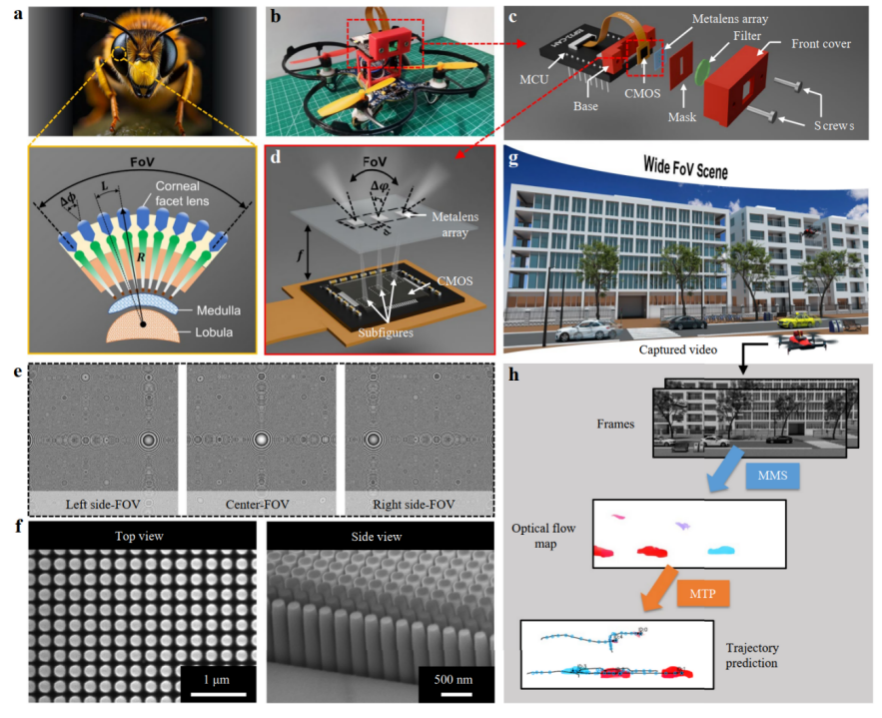
GA, UNITED STATES, May 18, 2026 /EINPresswire.com/ — Inspired by insect compound eyes, Prof. Ji Chen’s team from Southeast University proposes a bioinspired motion detector based on planar metalens arrays. It realizes an ultra-wide 135° field of view and achieves high-precision perception of moving targets’ velocity and direction. The design effectively detects tiny and slow-moving objects in complex backgrounds and enables intelligent motion trajectory prediction. Featuring high integration and lightweight structure, it provides solid technical support for autonomous perception, industrial early warning and unmanned intelligent systems.
The booming development of bionic vision and nanophotonics has greatly advanced intelligent perception technologies, continuously driving the innovation of miniaturized, wide-angle and high-precision photoelectric detection devices. In practical complex scenarios, there is an urgent demand for efficient perception and trajectory prediction of tiny, slow-moving targets. Nevertheless, traditional bionic eye systems mostly rely on curved lens arrays, suffering from complex fabrication, bulky volume and poor integration. Meanwhile, conventional machine vision algorithms lack robustness in recognizing subtle moving objects under cluttered backgrounds, greatly limiting their real-world applications.
In a new paper(doi:https://doi.org/10.37188/lam.2026.064) published in Light: Advanced Manufacturing, a research team led by Professor Ji Chen from Southeast University has proposed and demonstrated a bioinspired planar intelligent nanophotonic sensor based on metalens arrays. Leveraging the superior wavefront modulation capability of planar metalenses, the system achieves an ultra-wide viewing angle of 135°, breaking the dependence on traditional curved bionic eye structures. The team constructed a PSF-based convolution imaging model to generate high-fidelity datasets, and further developed a multi-scale motion perception network and a lightweight trajectory prediction framework. The sensor enables accurate extraction of velocity and direction information of moving targets, reliable identification of small and slow objects in complex environments, and intelligent prediction of subsequent motion trajectories. With high integration, ultra-thin profile and excellent environmental adaptability, the system can be easily embedded into various mobile platforms such as micro unmanned vehicles.
The developed bionic motion detector takes the planar metalens array as the core, integrated with optical filter, stray light mask and CMOS image sensor to form an all-in-one detection module. The research team summarized the core advantages of the system:“Inspired by insect compound eyes, we construct a 1×3 metalens array to realize planar ultra-wide-angle imaging. The established imaging model effectively solves the problem of insufficient dedicated datasets for metalens vision, while the designed neural network and prediction framework achieve high-precision perception and multi-target trajectory forecasting under interference backgrounds.”
“Benefiting from the lightweight algorithm architecture and high hardware integration, the system realizes millisecond-level trajectory prediction and stable continuous tracking of multiple crossing and overlapping targets,” they added.
“The proposed metalens-based bionic sensing scheme not only overcomes the bottlenecks of traditional curved bionic vision and ordinary machine vision, but also provides a feasible technical route for next-generation miniaturized intelligent photoelectric perception. This achievement opens new prospects for robotic vision, vehicle environmental perception, industrial safety early warning, low-altitude security monitoring and unmanned system autonomous decision-making without excessive volume and power consumption constraints,” the researchers forecast.
DOI
10.37188/lam.2026.064
Original Source URL
https://doi.org/10.37188/lam.2026.064
Funding information
This study was supported by the National High-Level Personnel of Special Support, Basic Research Program of Jiangsu (No. BK20252002), Young Elite Scientists Sponsorship Program by CAST (No.2022QNRC001), National Natural Science Foundation of China (Nos.61960206005 and 61871111), and Jiangsu Key R&D Program Project (No.BE2023011-2), Fundamental Research Funds for the Central Universities (No. 2242022k60001), and the Project of the National Mobile Communications Research Laboratory (No. 2026A03)
Lucy Wang
BioDesign Research
email us here
Legal Disclaimer:
EIN Presswire provides this news content “as is” without warranty of any kind. We do not accept any responsibility or liability
for the accuracy, content, images, videos, licenses, completeness, legality, or reliability of the information contained in this
article. If you have any complaints or copyright issues related to this article, kindly contact the author above.

Media gallery