
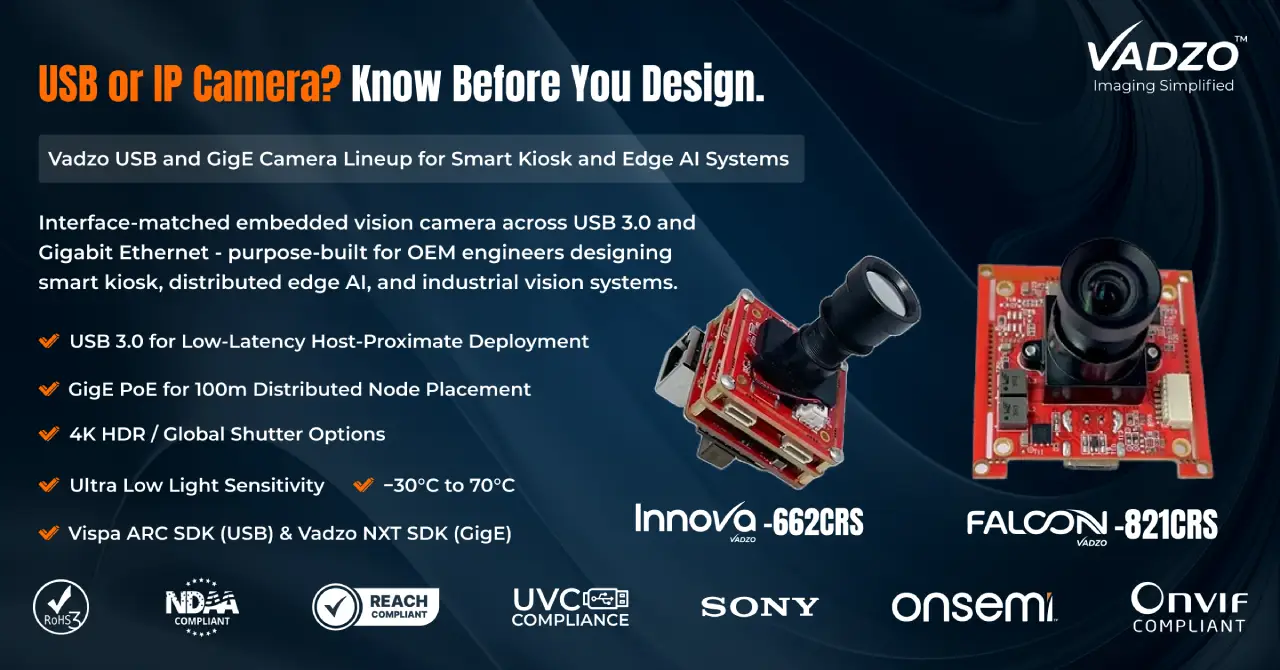
Vadzo Imaging’s Falcon USB camera series and Innova GigE camera series deliver purpose-matched embedded vision camera solutions for the USB Camera vs IP Camera integration decision, combining 4K HDR, global shutter precision, ultra-low light sensitivity, and long-reach Gigabit Ethernet networking across four OEM-ready platforms for smart kiosk and edge AI system design.
FORT WORTH, TX / ACCESS Newswire / May 14, 2026 / Vadzo Imaging, a provider of embedded vision cameras, is addressing one of the most consequential decisions embedded vision engineers face when designing smart kiosk and edge AI systems: the USB Camera vs IP Camera integration question. This choice is not theoretical. It determines cable-length constraints, latency characteristics, host processing load, network topology, power delivery architecture, and whether the imaging subsystem and Edge AI Camera architecture can meet real-time performance requirements in production.

The USB Camera vs IP Camera series decision rarely has a universal answer. A smart kiosk deployed at a retail checkout counter operates differently from a distributed edge AI inference node positioned at a transport terminal entry gate. A biometric access control panel requiring sub-20ms face detection latency has fundamentally different integration constraints than a multi-camera IP Camera Edge AI System streaming video across a facility-wide Gigabit Ethernet network. What embedded engineers need is not a generic comparison but sensor-level, interface-level guidance grounded in actual deployment architecture trade-offs.
Vadzo Imaging’s response is four purpose-built embedded vision cameras split across both sides of the USB Camera vs IP Camera boundary: the Falcon821CRS and Falcon-234CGS for USB-connected edge AI and smart kiosk applications, and the Innova-662CRS and Innova-234CGS for Gigabit Ethernet-connected distributed monitoring and IP-based inference deployments. Across all four, the engineering focus stays on the specific imaging problems each interface must solve, not on sensor specifications in isolation.
USB Camera vs IP Camera: The Integration Decision Framework
The USB Camera vs IP Camera question ultimately comes down to three system-level variables: physical deployment distance, host architecture, and real-time latency requirements.
USB 3.0 camera integration delivers direct-attach, zero-configuration streaming to a local host SBC or embedded compute module. Cable runs are constrained to approximately 5 metres without active extension, but within that range, a Low Latency Camera connected over USB offers deterministic data transfer, UVC class compliance that eliminates host-side driver development overhead, and USB bus power that simplifies embedded system power design. For a USB Camera for Edge AI deployment, such as a smart kiosk inference unit, a face authentication terminal, or an embedded barcode scanner, these characteristics directly reduce BOM complexity and integration time.
IP Camera integration via Gigabit Ethernet flips this trade-off. A Gigabit Ethernet Camera supports cable runs up to 100 metres over standard Cat5e/Cat6, enabling flexible node placement across facilities and campuses physically unreachable via USB. PoE consolidates power and data onto a single cable run. The Ethernet Camera model enables multi-camera streaming across a unified network fabric, with each camera addressable independently over standard TCP/IP. For distributed deployments at transport hubs, warehouse perimeters, and smart city edge nodes, the IP Camera Edge AI System architecture scales in ways that direct-attach USB cannot.
The USB Camera vs IP Camera decision, when evaluated at the system integration level rather than at the feature checklist level, clarifies which platform is actually right for the deployment. What follows is Vadzo’s engineering-grounded case for each.
Falcon821CRS: 4K AR0821 Color HDR USB 3.0 Camera for High-Fidelity Edge AI Capture
Smart kiosks and AI inference terminals that need to capture fine detail skin texture for liveness detection, QR code geometry at varying distances, or document features for automated verification cannot accept resolution compromises at the camera level. The Falcon821CRS, Vadzo’s 4K AR0821 Color HDR USB 3.0 Camera, is built around the onsemi AR0821 sensor delivering 8MP (3840×2160) imaging over USB 3.0 with HDR capability for high-contrast ambient conditions common to backlit kiosk positions and mixed indoor/outdoor deployments. Its UVC compliance makes it immediately enumerable on Linux and Windows embedded hosts without custom driver work, and its USB 3.0 interface delivers the low-latency, direct-attach data path that edge AI pipelines running on local NPUs or GPUs depend on for real-time inference performance.
Key specs: 8MP 4K (3848×2168) | onsemi AR0821 | Rolling Shutter | 1/1.7″ 2.1 µm Pixel Size | USB 3.0 (UVC) | HDR | S-Mount (M12) | -30°C to 70°C
Falcon-234CGS: AR0234 Color Global Shutter USB 3.0 Camera for Motion-Precise Edge Capture
Kiosk and embedded terminal applications that image moving hands, scan barcodes in motion, or track contactless gestures cannot tolerate rolling shutter distortion on fast-moving subjects. The Falcon-234CGS is Vadzo’s AR0234 Color Global Shutter USB 3.0 Camera, delivering 2MP (1920×1200) imaging with a global shutter that captures every pixel simultaneously, eliminating the geometric distortion that rolling shutter sensors produce on subjects moving through the frame during readout. The onsemi AR0234 sensor’s global shutter architecture makes the Falcon-234CGS 1080p global shutter USB 3.0 Camera the engineered choice for any USB-connected kiosk application where motion integrity is a hard system requirement: contactless checkout scanning, hand tracking, industrial inspection at a stationary embedded terminal, or document capture where physical paper moves through the field of view.
Key specs: 2MP (1920×1200) | onsemi AR0234 | Global Shutter | 1/2.6″ 3.0 µm Pixel Size | USB 3.0 (UVC) | S-Mount (M12) | -40°C to 85°C
Innova-662CRS: IMX662 Ultra Low Light Gigabit Ethernet Camera for Distributed Edge AI Nodes
When an edge AI node must be positioned beyond the 5-metre reach of USB at a building entry, across a transport terminal floor, or at a perimeter location in a warehouse, the USB Camera vs IP Camera architecture decision is made by the physical environment. The Innova-662CRS, Vadzo’s 2MP IMX662 Rolling Shutter Ethernet Camera, resolves this by delivering 2MP FHD (1920×1080) color imaging over a GigE interface with PoE delivery, enabling camera placement at distances up to 100 metres from the host or network switch over standard Cat5e/Cat6. The Sony STARVIS IMX662 sensor’s back-illuminated pixel architecture provides enhanced sensitivity in low-ambient environments, a critical capability for edge AI nodes deployed in dimly lit transport hubs, underground access points, or retail environments with variable overhead lighting. Up to 60fps FHD streaming feeds directly into an IP-based edge AI inference pipeline with HDR for high-contrast scene management.
Key specs: 2MP FHD (1920×1080) | Sony STARVIS IMX662 | Rolling Shutter | 1/2.8″ 2.9 µm Pixel Size | GigE (100/1000Base-T) | HDR | S-Mount (M12) | -40°C to 85°C
Innova-234CGS: 2MP AR0234 Color Global Shutter GigE Camera for Distributed Precision Capture
The Innova-234CGS extends the global shutter precision of the AR0234 sensor into GigE-networked deployments, making it the correct choice when the IP Camera Edge AI System architecture requires motion-accurate imaging across distributed nodes. As Vadzo’s 2MP AR0234 Color Global Shutter GigE Camera, it delivers 2MP (1920×1080) at up to 60fps over Gigabit Ethernet with a global shutter that eliminates rolling shutter distortion on fast-moving subjects. For distributed access control terminals, conveyor inspection systems, and smart facility nodes that need accurate motion capture with network-connected flexibility, the 1080P AR0234 GigE Camera combines the geometric precision of global shutter imaging with the deployment reach of a PoE-powered Ethernet interface, eliminating the need for separate power runs to each node position.
Key specs: 2MP (1920×1200) | onsemi AR0234 | Global Shutter | 1/2.6″ 3.0 µm Pixel Size | S-Mount (M12) | -40°C to 85°C
SDK Support: Vispa ARC for USB Cameras, Vadzo NXT SDK for Innova GigE Cameras
Both camera families carry dedicated developer SDKs aligned to their interface. The Falcon USB camera series is supported by Vispa ARC, providing programmatic control over streaming, ISP parameters, exposure, white balance, and region-of-interest configuration for USB-connected embedded applications across Linux and Windows platforms. The Innova GigE camera series is supported by the Vadzo NXT SDK, delivering equivalent camera control for network-connected deployments, including streaming, encoding, GPIO, Smart GPIO, ROI configuration, and firmware management. Both SDKs support C, C++, and Python, enabling OEM development teams to build across both the USB Camera and IP Camera sides of a hybrid edge AI system architecture without switching toolchains.
Applications: Where USB Camera vs IP Camera Integration Matters Most
Smart Kiosk and Point-of-Interaction Terminals: Falcon821CRS and Falcon-234CGS
Self-service kiosks, retail checkout terminals, biometric access panels, and document verification stations share a common architecture: a fixed compute host embedded within or adjacent to the kiosk enclosure, with a camera mounted within that enclosure. This is exactly the deployment model that USB 3.0 camera integration is engineered for. The Falcon821CRS 4K AR0821 USB 3.0 Camera delivers 4K HDR imaging for high-detail capture tasks requiring maximum resolution at the edge. The Falcon-234CGS 1080p AR0234 USB 3.0 Camera delivers global shutter precision for motion-sensitive scanning and gesture applications. Both cameras are UVC-compliant, reducing host-side driver work to near zero and enabling direct integration with inference frameworks on embedded compute.
Distributed Edge AI Nodes and IP-Based Monitoring: Innova-662CRS and Innova-234CGS
When the system architecture positions cameras beyond USB reach across a warehouse floor, at transport terminal entry gates, or distributed across a smart city edge network, the USB Camera vs IP Camera decision resolves clearly in favour of Gigabit Ethernet. The Innova-662CRS 1080P Color Gigabit Ethernet Camera handles low-light environments and high-contrast scenes with Sony STARVIS IMX662 sensitivity and HDR. The Innova-234CGS AR0234 Global Shutter GigE Camera handles fast-moving subjects in distributed access control and inspection systems where motion accuracy is a hard requirement. Both cameras deliver PoE-powered, network-addressable imaging that scales across multi-node deployments without requiring dedicated power runs to each position.
Vadzo OEM Commitment Across USB Camera and IP Camera Platforms
Across all four cameras, Vadzo provides OEM services that embedded product development teams depend on beyond the camera module itself. Full OEM customization covers board redesigns, firmware modifications, lens holder and filter modifications, and enclosure design support. ISP tuning is calibrated for actual deployment environments, not laboratory test benches. Volume pricing, production support, and direct applications engineering assistance for design-in guidance are available on request.
“The USB Camera vs IP Camera decision is not a product preference it is a system architecture constraint. Vadzo’s engineering approach is to provide purpose-built cameras on both sides of that constraint, so OEM teams can select the correct imaging platform for their deployment environment without compromising on sensor performance, latency, or integration complexity.” – Alwin Vincent, Product Manager, Vadzo Imaging.
Frequently Asked Questions (FAQs)
1) Which interface should I use for a smart kiosk: USB Camera or IP Camera?
For a smart kiosk with an embedded compute host within 5 metres of the camera, a USB camera eliminates network configuration overhead and delivers deterministic low-latency data transfer. The Falcon821CRS (4K AR0821 Color HDR USB 3.0 Camera) covers high-detail capture requirements; the Falcon-234CGS (AR0234 Color Global Shutter USB 3.0 Camera) covers motion-precise scanning and gesture applications. Both enumerate as UVC devices on Linux and Windows hosts with no custom driver work required.
2) What is the maximum deployment distance for a Gigabit Ethernet Camera in an edge AI system?
A Gigabit Ethernet Camera supports cable runs up to 100 metres over Cat5e/Cat6, with PoE delivering both power and data over a single cable. The Innova-662CRS (2MP IMX662 Rolling Shutter Ethernet Camera) and Innova-234CGS (2MP AR0234 Color Global Shutter GigE Camera) both operate at full specification across this distance without active extension hardware.
3) Does a USB camera introduce higher latency than an IP camera for real-time inference?
USB 3.0 lets you connect a camera directly to your computer, moving data fast and with more predictable timing faster than what you’d get through a GigE network, which has extra layers slowing things down. So if you’re working with just one camera and need real-time AI processing right at the device, USB is usually your best bet. Compared to IP cameras, USB almost always wins on latency for edge AI setups. IP cameras, or GigE in general, tack on more overhead from the network stack, but they make it possible to run things over longer cables or across multiple devices, something USB simply can’t do.
4) Which Vadzo camera is best suited for global shutter applications in networked deployments?
The Innova-234CGS is Vadzo’s 2MP AR0234 Color Global Shutter GigE Camera. It gives you true global shutter performance across a PoE-powered Gigabit Ethernet connection. If you need motion accuracy for things like inspection stations, conveyor belts, or access control systems spread out over a network, this camera gets the job done.
5) Can Vadzo customize these cameras for specific enclosure or board-level integration requirements?
Yes. Vadzo provides full OEM customization across the Falcon USB camera series and Innova GigE camera series, covering board redesigns, lens holder and filter modifications, firmware customization, and enclosure design. Direct applications engineering support for design-in is available from the Vadzo team for both USB Camera and IP Camera platforms.
Availability
The Falcon821CRS 8MP AR0821 Color USB Camera, Falcon-234CGS 2MP AR0234 USB Camera, Innova-662CRS IMX662 Gigabit Ethernet Camera, and Innova-234CGS 1080P AR0234 Gigabit Ethernet Camera are available for OEM evaluation. Evaluation kits, technical documentation, and integration support are available directly from Vadzo Imaging. Volume pricing, firmware customization, optics, and enclosure design services are available upon request. For inquiries, contact the Vadzo sales team at support@vadzoimaging.com.
About Vadzo Imaging
Vadzo Imaging develops high-performance embedded and machine vision cameras for OEMs and system integrators building next-generation intelligent systems. The company delivers imaging platforms across USB, MIPI, GigE, Wi-Fi, and SerDes interfaces, supporting applications in industrial automation, robotics, smart surveillance, smart city infrastructure, and edge AI. Beyond hardware, Vadzo provides end-to-end imaging expertise, including sensor integration, ISP tuning, firmware development, and OEM customization services that accelerate development and deployment at scale.
Media Contact:
Alwin Vincent
Vadzo Imaging
Email: alwin@vadzoimaging.com
LinkedIn: Vadzo Imaging
YouTube: Vadzo Imaging
X: Vadzo Imaging
SOURCE: Vadzo Imaging
View the original press release on ACCESS Newswire