
New Analysis Examines Portugal Golden Visa in 2026 Amid Policy and Processing Changes
LOS ANGELES, CA, UNITED STATES, April 27, 2026 /EINPresswire.com/ — Immigrant Invest has published a new analysis of the Portugal Golden Visa in 2026. It explains how the programme has moved beyond its earlier real-estate-driven model and developed into a narrower route shaped by regulatory change, administrative restructuring, and a different framework.
Why the Portugal Golden Visa looks different now
The Portugal Golden Visa looks different now because both its legal structure and its administrative framework have changed. It still exists, but it no longer operates in the way many international investors remember.
Portugal first limited where qualifying residential property could be purchased and then, under the 2023 Mais Habitação reform, removed real estate and large unrestricted capital transfers for new applicants. At the same time, responsibility for the Golden Visa applications moved from SEF to AIMA after a wider reform of Portugal’s migration administration.
The Portugal Golden Visa in 2026 needs to be assessed not only through its legal rules, but also through the practical reality of how applications, renewals, and appointments are now handled.
Key report findings
The analysis shows how far the Portugal Golden Visa has moved away from the model that once defined it. From its launch in 2012 to late 2023, more than €7.3 billion was attracted through the Golden Visa, and around 88% of that total went into property.
Today, the programme is limited to non-property investment routes, including:
• purchase of investment fund units;
• contributions to scientific research;
• support for art and cultural heritage;
• job creation;
• business investment.
Together, these routes reflect the Portugal Golden Visa’s current focus on investment channels outside residential property. For investors, this means the route is no longer centred on a single property purchase, but on selecting the option that best fits their goals, priorities, and overall investment approach.
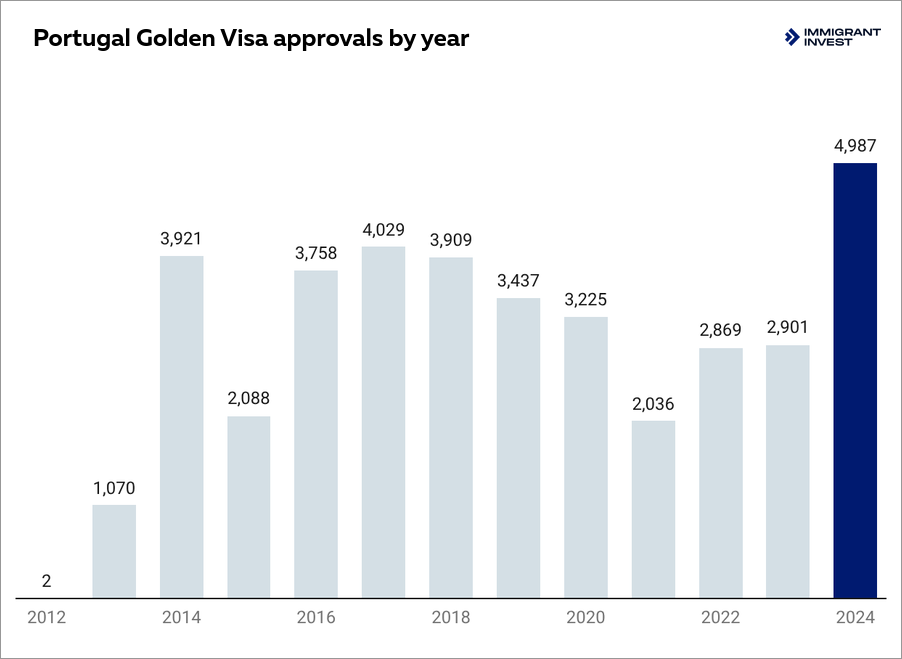
In addition, the analysis shows how much the administrative side now matters. When AIMA took over from SEF, it inherited more than 50,000 pending applications. In 2024, AIMA issued 2,081 permits to main investors and 2,909 to family members, which reflects both continued activity and the effects of backlog clearance.
At the same time, one of the route’s key practical features remains unchanged: the minimum stay requirement is still low, at 7 days in the first year and 14 days in each following two-year period.
Short historical arc
Portugal launched the Golden Visa in 2012 during a severe economic downturn, when the country needed foreign capital and had limited room for traditional economic stimulus. It was designed to attract investment quickly, and property soon became its dominant route.
Over time, the Portugal Golden Visa brought substantial inflows and became one of the best-known residence by investment options in Europe. But because most investment went into real estate and was concentrated in high-demand locations such as Lisbon, Porto and the Algarve, the Golden Visa also became tied to housing pressure and political criticism.
The reforms of 2022 and 2023 changed that trajectory. By removing the property route for new applicants and shifting the programme toward non-property investment, Portugal reshaped the Golden Visa into a different policy instrument.
Seen from 2026, the Portugal Golden Visa operates in a different form and serves a different policy purpose from the one that defined its early years.
About Immigrant Invest
Immigrant Invest, a consulting company with 20 years of experience in investment migration, prepared the analysis as a research-based review of the Portugal Golden Visa from 2012 to 2026.
The analysis brings together official statistics, legislation, and institutional materials from sources including AIMA, the former SEF, Statistics Portugal, and Banco de Portugal. It also places the Portugal Golden Visa in a broader policy context through publications from the European Commission, the OECD, and the IMF.
The analysis is intended to help readers understand what changed and how those changes have reshaped the Portugal Golden Visa’s logic in 2026. Read the full text on the Immigrant Invest website.
Eymi Castro
Immigrant Invest
+356 2033 0178
email us here
Legal Disclaimer:
EIN Presswire provides this news content “as is” without warranty of any kind. We do not accept any responsibility or liability
for the accuracy, content, images, videos, licenses, completeness, legality, or reliability of the information contained in this
article. If you have any complaints or copyright issues related to this article, kindly contact the author above.

Media gallery