New VoC data from Clootrack shows GLP-1 users shop on a 7-day pharmaceutical cycle that has no relationship to retail’s weekly promotional cadence.
NEW YORK, NY, UNITED STATES, April 15, 2026 /EINPresswire.com/ — Retail’s weekly promotion cycle was built on one assumption: consumers shop on a predictable weekly rhythm, and forecasting models calibrated to decades of that pattern work.
GLP-1 medications have introduced a variable that decades of purchase data cannot account for: a pharmaceutical injection cycle that resets consumer appetite, tolerance, and purchase motivation on a schedule with nothing to do with the retail calendar.
Clootrack analyzed 95,854 GLP-1 consumer conversations between January 2022 and December 2025 using its Voice of Customer analytics platform. What the data surfaces is not a shift in what consumers prefer. It is a shift in when they are physiologically capable of purchasing, and current promotional infrastructure cannot see it.
Clootrack was recognized by OpenAI last year for processing over 100 billion tokens in Voice of the Customer analytics.
Day 1 and Day 6 are not the same for GLP-1 consumers
Every GLP-1 user on a weekly injection cycle produces two distinct shopping profiles within a single week. In the suppression window (days 1 through 3 post-injection), appetite is suppressed, nausea sensitivity is elevated, and food tolerance narrows to gentle, functional categories. By days 6 and 7, appetite normalizes, food interest returns, and purchase intent is back.
“I inject on Sundays. Monday and Tuesday I can’t even think about food. Wednesday I’m OK. Thursday and Friday I’m actually hungry. Saturday I eat like a normal person and I’m actually enjoying food. Then Sunday I dread the shot because I know what’s coming.”
This is not anecdotal. The behavioral signal is already present at scale in consumer conversation data:
– GI symptom conversations: 40.8% month-over-month growth at 9.3% positive sentiment
– Hydration practices: 99.3% month-over-month growth at 62.4% positive sentiment
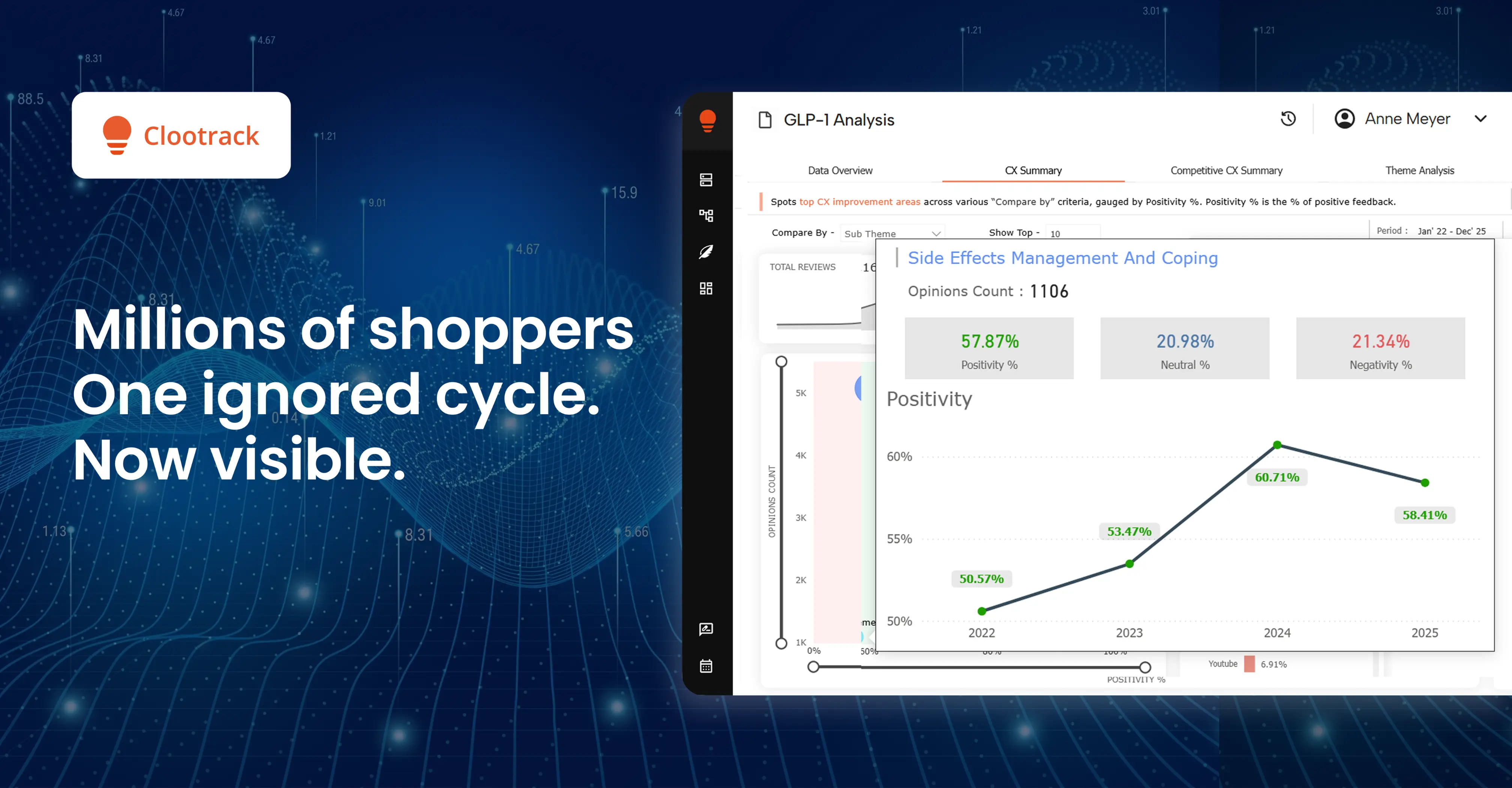
– Side effects management: 43.4% month-over-month growth at 57.9% positive sentiment
Consumers have already reorganized their shopping week around the cycle:
“I plan my whole week around my injection. I grocery shop on Thursday when I have energy. I meal prep on Saturday before my appetite crashes. I don’t make dinner plans Monday-Wednesday because I can’t predict if I’ll be too nauseous.”
A Tuesday promotion on hearty proteins or fresh meal kits reaches a GLP-1 user on Day 2, the wrong purchase window. The same promotion on Friday reaches an entirely different intent state. Standard forecasting sees a flat weekly demand signal. The consumer is experiencing a demand cliff and recovery every single week.
Promotional ROI is leaking through a gap nobody is measuring
Category managers running post-mortems on underperforming weekly promotions are diagnosing the output, not the cause.
Volume deals landing on Day 2 of the injection cycle, fresh markdown timed to mid-week clearance, meal occasion bundles positioned for a consumer in a suppression window: none of this shows up in dashboards as a GLP-1 signal. It surfaces as unexplained variance, shrink, and markdown waste.
“The first 3 days after my dose, I’m buying ginger ale, crackers, and soup. The last 3 days, I’m buying real groceries. My cart looks completely different depending on where I am in my week.”
Grocery and food budget conversations are up 109.7% month-over-month in this dataset. That is not a category growth signal. It is a reorganization signal. GLP-1 households are actively recalibrating what they spend on food and when. The promotional models calibrated to their old behavior are running on inputs that no longer describe the consumer standing in the aisle.
The weekly GI regimen is unclaimed recurring revenue
Inside the suppression window, GLP-1 users are not making isolated product decisions. They are assembling structured weekly regimens: ginger, electrolytes, gentle starches, OTC anti-nausea relief, broths. Purchased together. Deployed in sequence. Restocked every week or bought for multiple weeks without a promotional trigger.
“Once I learned how to manage them by drinking a ton of water, ginger pills are essential, and Gas-X when necessary, they became manageable.”
The sentiment data tells the commercial story precisely. Gastrointestinal Symptoms sit at 9.3% positive sentiment. Side Effects Management and Coping sits at 57.9% positive. That gap is not a health outcome. It is a retail opportunity: consumers have found the solution stack, they are satisfied with it, and they are restocking it on a pharmaceutical schedule regardless of what is on promotion.
The economic unit is not a SKU. It is a weekly ritual. Retailers who build cross-aisle regimen displays and position them explicitly for GLP-1 management capture recurring weekly purchase from a consumer who is not waiting for a promotional reason to buy.
The forecast model is running on an assumption that has expired
Grocery forecasting models run on historical purchase patterns generated by consumers who shopped on hunger and habit. GLP-1 introduces a third variable: a pharmaceutical schedule that no historical dataset has ever captured and no current model is weighting.
The dose calendar effect is measurable now in Voice of Customer data. It will confirm in transaction data later, after the behavioral pattern has hardened and retailers have already absorbed the forecast variance and promotional waste that come with the delay. Category managers and VP Commercial Strategy leaders who recalibrate now are not reacting to this shift. They are building ahead of it.
Full GLP-1 demand analysis report: The GLP-1 effect on U.S. retail 2026.
Methodology
This analysis is based on 95,854 GLP-1-related consumer conversations collected between January 2022 and December 2025, with 340,725 opinions extracted across forums, social media, and health review sites. Clootrack’s platform, recognized by OpenAI for processing over 100 billion tokens, uses patented unsupervised AI thematic detection operating at 98% accuracy across 55+ languages. All findings are directional signals from consumer conversation data and do not represent verified sales, revenue, or market share figures.
VoC Research
Clootrack
contactus@clootrack.com
Legal Disclaimer:
EIN Presswire provides this news content “as is” without warranty of any kind. We do not accept any responsibility or liability
for the accuracy, content, images, videos, licenses, completeness, legality, or reliability of the information contained in this
article. If you have any complaints or copyright issues related to this article, kindly contact the author above.

Media gallery