
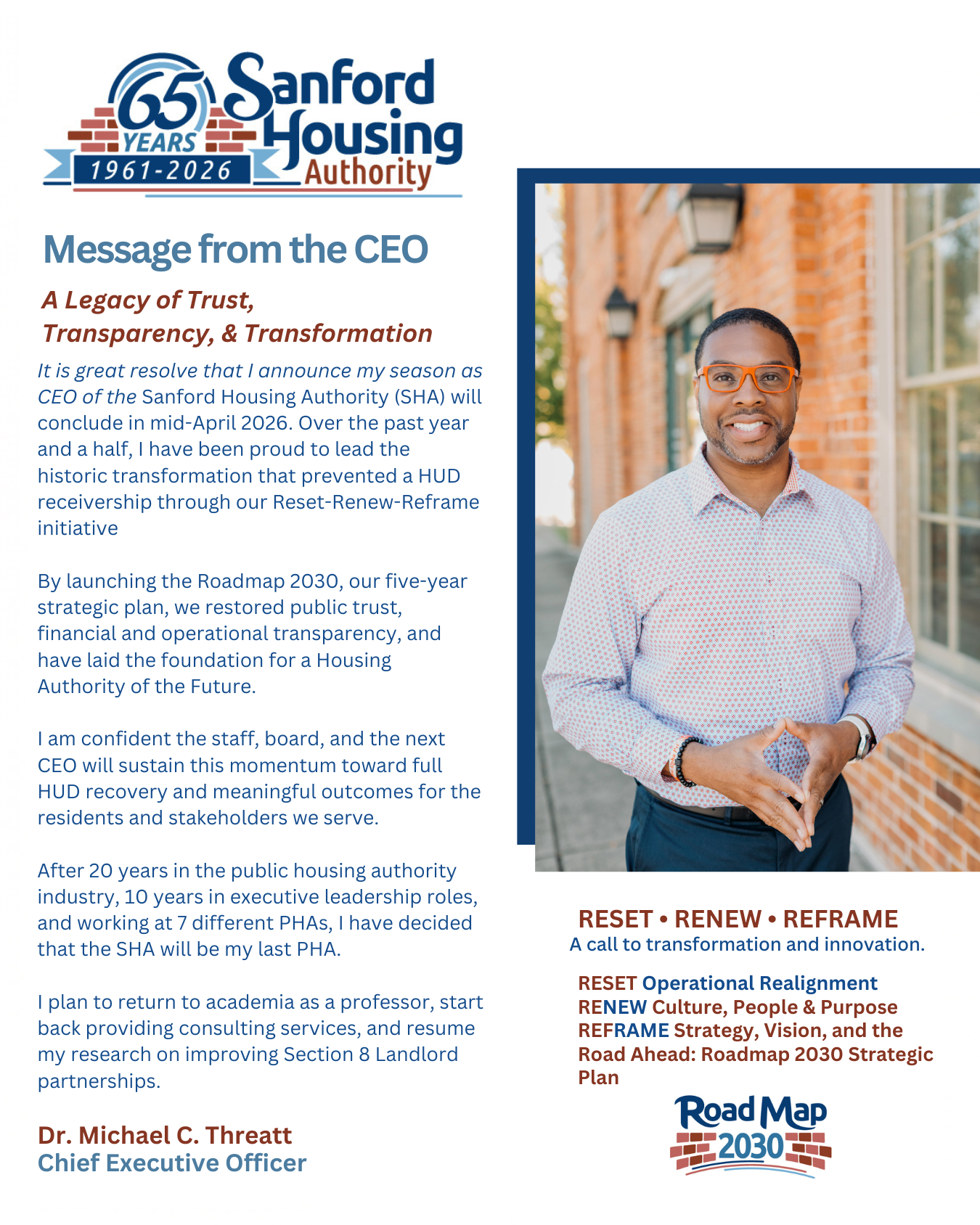
SHA’s CEO, Dr. Michael C. Threatt, Discusses Leaving a Legacy of Trust, Transparency, and Transformation as his season comes to an end after 17 months.
SANFORD, NC, UNITED STATES, April 19, 2026 /EINPresswire.com/ — Dr. Michael C. Threatt, Chief Executive Officer (CEO) of the Sanford Housing Authority (SHA), will conclude his service on April 20, 2026, leaving behind a legacy defined by trust, transparency, and transformation. Dr. Threatt delivered his final State of the Housing Authority Address on Monday, April 13, 2026, during the Sanford Area Growth Alliance’s (SAGA’s) Public Policy Luncheon and released SHA’s “Better Together Performance Report” as his legacy manifesto.
Since joining the agency in December 2024, Dr. Threatt has led one of the most comprehensive organizational turnarounds in SHA’s 65-year history, advancing the Authority from HUD-designated troubled status under a Recovery Agreement toward long-term operational stability, financial integrity, and sustained HUD recovery, while preventing federal judicial receivership.
When Dr. Threatt assumed leadership, the Sanford Housing Authority faced significant systemic challenges, including deteriorated housing units, outdated policies, weakened internal controls, low inspection scores, staffing gaps, and eroded public trust.
Within his first 90 days, Dr. Threatt executed a formal HUD Recovery Agreement, which immediately triggered an agency-wide corrective action process focused on governance, operations, compliance, and accountability.
Roadmap 2030: Reset-Renew-Reframe
Under Dr. Threatt’s leadership, SHA launched Roadmap 2030: A Strategic Path Forward, a five-year strategic plan grounded in the principles of Reset-Renew-Reframe. The plan modernized governance, restored regulatory compliance, strengthened workforce capacity, repositioned the public housing portfolio, and redefined SHA’s role as a housing authority prepared for the future.
Roadmap 2030 served as the framework guiding the Authority’s recovery and long-term vision, ensuring improvements were systematic, measurable, and durable.
Reestablishing Financial Capacity and Transparency
The Authority’s recovery was further complicated by the prior loss of its nationally recognized fee accountant, BDO PHA Finance, due to organizational instability. Reengaging BDO required demonstrable improvements in transparency, governance, and financial discipline.
Under Dr. Threatt’s leadership and with stronger internal controls, SHA restored this critical professional partnership, strengthening technical capacity and compliance efforts.
As financial stabilization progressed, leadership identified legacy issues from the prior administration’s abrupt exit from the Yardi housing software system and return to SACS.
This decision led to irretrievable data loss, complicating audit reconstruction and delaying the FY2024 and FY2025 HUD Financial Data Schedule submissions. Portions of the forensic audit conducted by CliftonLarsonAllen (CLA) could not be completed due to these data gaps and records lost during a flood-related administrative relocation.
To prevent future breakdowns, Dr. Threatt championed Reframe Assist housing software and ClearGov transparency software. The ClearGov platform offers real-time budget visibility, public-facing dashboards, and greater accountability to HUD, residents, and stakeholders. These combined actions eliminated more than $400,000 in delinquent obligations, stabilized cash flow, and restored fiscal credibility.
“I would like to publicly acknowledge Ms. Deborah Kauba for standing in the gap for the Sanford Housing Authority and taking on the audacious task of rebuilding the finance department,” said Dr. Threatt. “If she had not accepted the role and if BDO had not reengaged, we would not have crossed several critical milestones, and our conversation regarding a HUD judicial receivership would have been very different.”
Major Milestones and Outcomes
Financial Stability and HUD Recovery
Early priorities focused on restoring financial discipline, transparency, and credibility with HUD. SHA implemented more than 16 HUD-aligned financial policies, strengthened internal controls, procurement, and contract management oversight, and board governance practices in alignment with the HUD Recovery Agreement. The ClearGov Financial Transparency Software Initiative enhanced both internal visibility and public accountability.
Dramatic Maintenance Performance Improvements
Longstanding maintenance challenges were addressed through systemwide operational changes and external expertise. AMP 1 improved from a REAC score of 49 in 2022 to an NSPIRE score of 81 in 2025. AMP 3 improved from a REAC score of 75 to an NSPIRE score of 91. Matthews Court, a RAD PBV-LIHTC community, achieved an NSPIRE score of 95. Maintenance operations were strategically outsourced to Premier Contracting Professionals, and a New Maintenance Standard was established to reinforce long-term compliance across all properties.
Collectively, these improvements strengthened housing stability, enhanced resident safety, improved day-to-day living conditions, and restored HUD confidence in the Authority’s operational capacity.
Affordable Housing Preservation and Redevelopment
SHA advanced the high-priority demolition and redevelopment of Stewart Manor, including RAD PBV conversion protocols, transfer of assistance approvals, and modernization timelines. A comprehensive public housing repositioning study was commissioned with Dominion Due Diligence Group to guide future mixed-finance and mixed-income redevelopment.
Resident Services and Economic Mobility
Resident-centered investment remained a core focus. SHA secured its fifth Family Self-Sufficiency (FSS) grant and submitted competitive applications for ROSS and Jobs Plus, positioning the Authority to establish Economic Mobility Hubs focused on workforce training, financial coaching, and self-sufficiency. SHA hosted its first FSS graduation ceremony in more than five years and expanded resident services by implementing modern case management systems and building multi-sector partnerships.
Public Safety and Community Engagement
Public safety initiatives emphasized prevention and coordination. SHA launched the Public Safety and Prevention Framework, upgraded lighting and camera systems, implemented CPTED strategies, and installed Tsunami camera systems and license plate readers across public housing and RAD PBV sites to support crime prevention and real-time monitoring.
Organizational Culture, Technology, and Policy Modernization
SHA rebuilt its workforce capacity, increasing the number of certified housing professionals from 7 to 16. A modern C-suite leadership structure was implemented alongside updated job descriptions, salary studies, onboarding systems, and a new employee handbook. The Authority introduced the I CAN, and WE CAN Core Values Framework and unveiled new branding aligned with Roadmap 2030.
Technology enhancements included a redesigned, mobile-responsive website and application, expanded digital access, and new operational platforms supporting procurement, compliance, financial reporting, and case management. SHA updated and adopted 15 major program policies, including the Administrative Plan and ACOP, and launched the Attract-Recruit-Retain Landlords in Central Carolina Marketing Campaign.
Leadership Reflections and Transition
“Do the best you can, while you can, with what you can, and then save the rest for your succession plan. I am humbled to have served as the CEO of the SHA for the past 17 months, and the legacy I left,” said Dr. Michael C. Threatt, CEO of the Sanford Housing Authority (NC).
Karoll Kuri
Sanford Housing Authority
+1 919-776-7655
email us here
Visit us on social media:
LinkedIn
YouTube
Instagram
Facebook
Other
Who Tells Your Story? Why Housing Authorities Must Own the Narrative
Legal Disclaimer:
EIN Presswire provides this news content “as is” without warranty of any kind. We do not accept any responsibility or liability
for the accuracy, content, images, videos, licenses, completeness, legality, or reliability of the information contained in this
article. If you have any complaints or copyright issues related to this article, kindly contact the author above.

Media gallery