
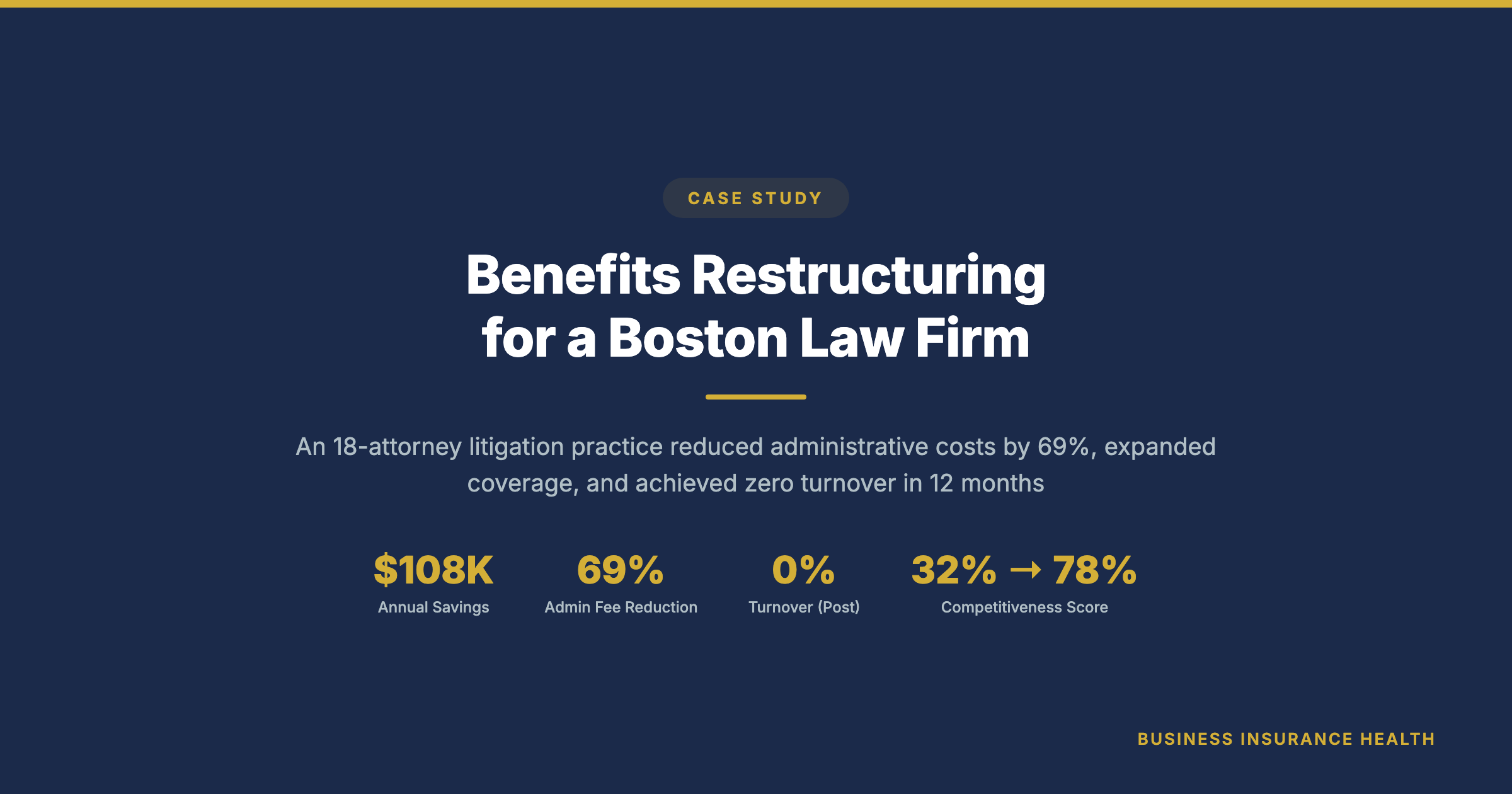
After a benefits audit and cost analysis, an 18-person litigation practice cut admin costs by 69 percent and expanded coverage while reducing total spend
BOSTON, MA, UNITED STATES, April 14, 2026 /EINPresswire.com/ — A boutique litigation practice in Boston, Massachusetts (https://peo4you.com/massachusetts-health-plan/) has reported measurable improvements in employee retention, benefits competitiveness, and administrative cost efficiency after restructuring its benefits strategy and exiting a traditional PEO arrangement.
The Henderson Law Firm, an 18-attorney specialized litigation practice with 12 support staff, made the transition in 2025 after conducting a benefits audit and cost modeling analysis. The firm reported a 60 percent reduction in administrative fees, expanded benefits coverage, and zero employee turnover in the 12 months following the change.
Industry Context
Professional services firms — particularly small and mid-size law practices — face persistent challenges in benefits administration and talent retention. According to the National Association for Law Placement, associate turnover at firms with fewer than 50 attorneys has averaged between 20 and 30 percent annually in recent years. The American Bar Association has noted that benefits quality is a leading factor in lateral hiring decisions, especially among junior and mid-level associates.
For boutique firms, the challenge is structural. They lack the scale to negotiate competitive group rates on their own, and many turn to PEO arrangements (https://businessinsurance.health/peo-service/) to access pooled benefits. However, PEO administrative fees can consume a disproportionate share of total benefits spending, and the benefits packages offered through these arrangements do not always match what larger firms provide.
These dynamics create a retention gap. Smaller firms invest in training and developing attorneys, only to lose them to larger competitors that offer stronger benefits, retirement plans, and HR support. The cost of replacing an attorney — including recruiting, onboarding, and lost productivity — is estimated at one to two times annual salary.
The Firm’s Situation Before the Change
The Henderson Law Firm had operated under a traditional PEO arrangement since 2019. The firm’s total annual benefits cost was $576,000, consisting of $487,000 in premiums and $89,000 in administrative fees — approximately $4,000 per employee per year in administrative overhead alone.
Despite this spending, the firm’s benefits package was limited to medical, dental, and vision coverage. There was no mental health coverage, no 401(k) match, no life insurance, no disability coverage, no wellness programs, and no professional development funding.
Using the Benefits ROI Calculator (https://businessinsurance.health/benefits-roi-calculator/), the firm assessed its benefits competitiveness at 32 percent against industry benchmarks. The ideal competitiveness threshold for attracting and retaining talent in the legal sector was estimated at 65 percent. The gap was significant.
In the 12 months prior to restructuring, the firm had lost three attorneys and two support staff — a 28 percent annual turnover rate.
The Restructuring Process
The firm conducted a comprehensive cost and strategy analysis. Using the Premium Renewal Stress Test (https://businessinsurance.health/businessinsurance-stress-test/), the firm modeled six-year cost projections across five strategies: fully insured, PEO, self-funded, strategic captive, and Taft-Hartley trust.
The analysis indicated that a strategic captive arrangement (https://businessinsurance.health/captive-insurance/) — which pools boutique professional services firms to smooth claims volatility — offered more competitive pricing than the existing PEO model. The firm also used the Business Valuation Tool (https://businessinsurance.health/business-valuation-tool/) to assess how HR infrastructure and benefits quality affected its enterprise valuation. The tool estimated a $1.6 million difference between the firm’s current valuation ($6.2 million) and projected valuation ($7.8 million) if HR infrastructure and benefits gaps were addressed.
Based on this analysis, the firm exited its existing PEO and moved health benefits into a strategic captive arrangement.
The New Benefits Structure
The restructured benefits package included:
Medical plan with the same network and deductible structure. Dental, vision, mental health, and telehealth coverage — all newly added. A 401(k) with 3 percent employer match — newly added. Life insurance, short-term disability, and long-term disability — newly added. An employee assistance program covering counseling, legal, and financial services. Health coaching and wellness programs. Professional development funding of $2,000 per employee per year. Formalized flexible work arrangements.
Total cost moved from $576,000 (premiums plus admin under the old PEO) to $468,000 (premiums plus admin under the new arrangement). The firm reduced total annual benefits spending by $108,000 while substantially expanding coverage.
Administrative fees dropped from $89,000 to $28,000 per year — a 69 percent reduction.
Measured Outcomes
Within 90 days of the benefits change, the firm conducted anonymous employee satisfaction surveys. Benefits satisfaction increased from 41 percent to 74 percent.
Turnover in the 12 months following the restructuring was zero — compared to 28 percent in the prior year.
Recruitment also improved. When the firm posted an associate attorney position, it received 31 applications, compared to a historical average of eight to nine. The firm attributed this partly to the expanded benefits package, which was now competitive with larger firms in the market.
The firm’s 401(k) participation increased from 6 employees to 22 out of 30, generating improved tax deductions for the firm and improved retirement savings for employees.
Running the Benefits ROI Calculator again after restructuring, the firm’s benefits competitiveness score increased from 32 percent to 78 percent.
“We were losing people to bigger law firms,” said Jennifer Chen, managing partner of Henderson Law Firm. “We thought we could not compete on benefits. But when we ran the numbers, we realized we were spending more than we needed to on an arrangement that was not delivering value. We restructured, expanded coverage, and reduced costs. Now we are keeping people.”
ABOUT PEO4YOU / BUSINESS INSURANCE HEALTH
PEO4YOU (https://peo4you.com/), in partnership with Business Insurance Health (https://businessinsurance.health/), is a Boston-based independent benefits consulting firm founded by Sam Newland, CFP. The firm provides coverage in Massachusetts (https://peo4you.com/massachusetts-health-plan/) and nationwide (https://peo4you.com/nationwide-health-plan-coverage/), helping small and mid-size employers access enterprise-level benefits, HR support, and cost-reduction strategies through PEOs, self-funded and level-funded health plans, captive insurance, and Taft-Hartley trusts. Its Benefits Intelligence Platform at businessinsurance.health provides employers with actuarial-grade modeling tools. PEO4YOU is part of the Newland Group Insurance family of companies and contributes to a medical debt forgiveness initiative with every client engagement.
SAMUEL DAVID NEWLAND
PEO4YOU
+1 857-255-9394
email us here
Visit us on social media:
LinkedIn
Instagram
Facebook
YouTube
X
Legal Disclaimer:
EIN Presswire provides this news content “as is” without warranty of any kind. We do not accept any responsibility or liability
for the accuracy, content, images, videos, licenses, completeness, legality, or reliability of the information contained in this
article. If you have any complaints or copyright issues related to this article, kindly contact the author above.

Media gallery